Back to Home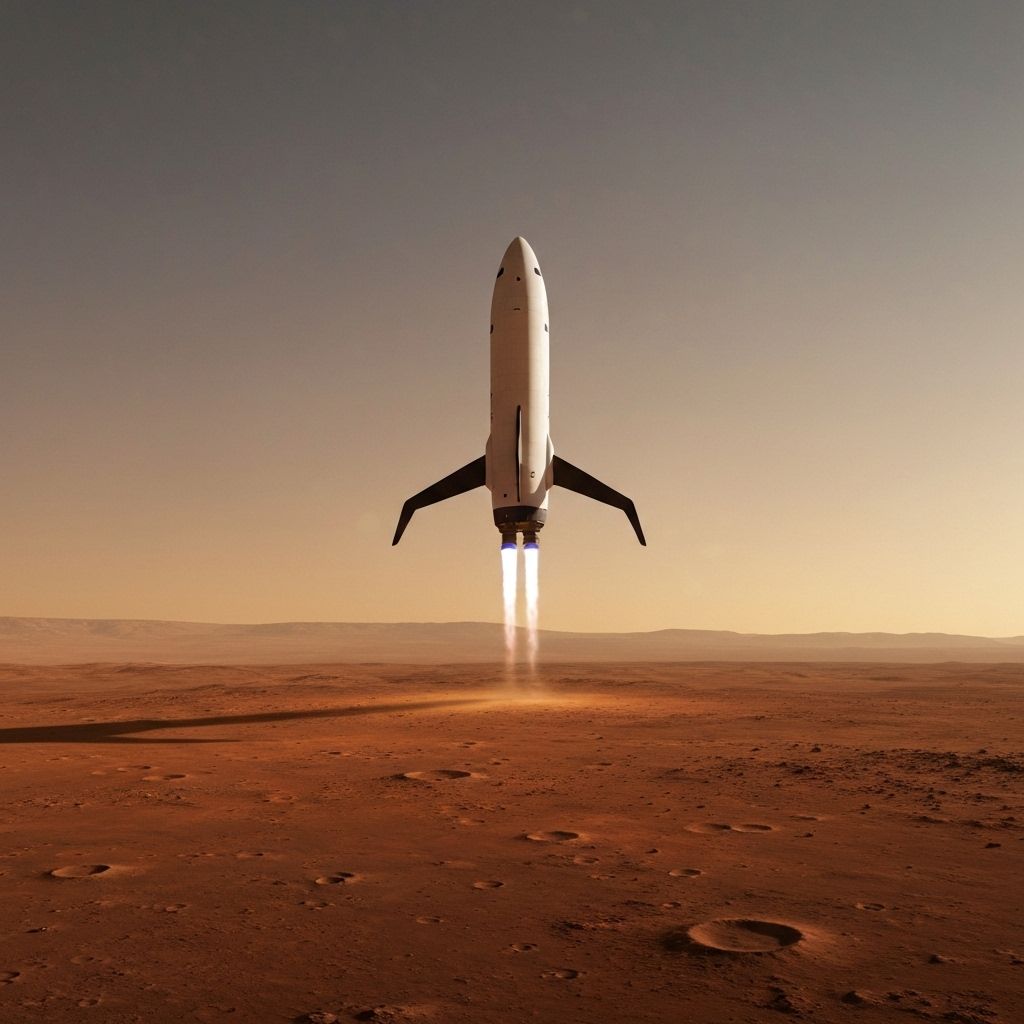



SpaceX Starship Successfully Completes First Mars Mission Simulation
By James Parker•October 28, 2024•
10 min read
•28,500 views
SpaceX has successfully completed the first full Mars mission simulation with their Starship spacecraft, marking a historic milestone in humanity's quest for interplanetary travel. The comprehensive test included all critical mission phases from launch to landing on simulated Martian terrain.
James Parker, SpaceX's Lead Mission Architect, described the achievement as 'a giant leap toward making Mars colonization a reality.' The simulation involved a complete 40-day mission profile, testing life support systems, radiation protection, propulsion systems, and landing protocols in conditions closely mimicking the Red Planet.
The Starship vehicle, the largest and most powerful spacecraft ever developed, demonstrated flawless operation throughout the simulation. Key innovations tested included the advanced thermal protection system that will shield the craft during Mars' thin atmosphere entry and the precision landing thrusters that allow pinpoint touchdown in challenging terrain.
Equally important were the life support systems that maintained a habitable environment for the crew of six astronauts throughout the simulation. These systems successfully recycled air and water with over 98% efficiency, a critical requirement for long-duration space missions.
Another major breakthrough was the successful testing of the in-situ resource utilization (ISRU) equipment that will extract water ice from Mars' subsurface and convert it into rocket propellant for the return journey. This technology eliminates the need to carry return fuel from Earth, dramatically reducing mission mass requirements.
Elon Musk, SpaceX's founder and CEO, praised the team's achievement but emphasized that there is still significant work ahead. 'This successful simulation shows we have the technical capability to reach Mars, but we must continue to refine systems and reduce costs to make regular missions economically viable,' Musk stated during a post-mission press conference.
NASA Administrator Bill Nelson congratulated SpaceX on the achievement, noting that this progress aligns with NASA's own Mars exploration goals. 'This milestone brings us closer to the day when humans will set foot on Mars, expanding the boundaries of human exploration and knowledge,' Nelson said.
The next phase of testing will involve an uncrewed mission to Mars' orbit and return, targeted for launch in 2026, followed by a crewed landing mission planned for 2030.
You May Also Like
View AllMeta wants to get into the electricity trading business
2 minNov 22
High-plex spatial RNA imaging in one round with conventional microscopes using color-intensity barcodes
9 minOct 30
Character AI will offer interactive ‘Stories’ to kids instead of open-ended chat
4 minNov 25
ChatGPT launched three years ago today
4 minNov 30